how to choose the correct tubing key questions to ask
How to Choose the Correct Tubing: Key Questions to Ask
Published: 18 February 2026
Read Time: 1.705 mins
Selecting the correct flexible tubing (for fluid, gas, or other applications) depends on several key factors. Asking the right questions up front helps ensure compatibility, safety, and durability. Here’s a comprehensive list of questions you should ask (or be prepared to answer) when buying flexible tubing:
🧪 1. What will flow through the tubing?
- What medium will it carry? liquid, gas, air, chemicals, fuel, food, etc.?
- Is the medium corrosive, abrasive, or reactive?
- Is it potable (drinking) or medical-grade material required?
Will there be particulate matter or is it a pure fluid?
🌡️ 2. What are the operating conditions?
- Temperature range: Minimum and maximum temperatures the tubing will face.
- Pressure range: Maximum working pressure and possible pressure surges (PSI or bar).
- Vacuum rating: If used under suction.
Ambient conditions: Exposure to sunlight (UV), ozone, chemicals, or moisture?
⚙️ 3. What are the mechanical requirements?
- Flexibility: How much bending or movement will the tubing undergo?
- Kink resistance: Will it be bent tightly or moved often?
- Abrasion resistance: Will it rub against other surfaces?
Compression or impact resistance: Will it be stepped on or subjected to load?
📏 4. What are the dimensional requirements?
- Inner diameter (ID) and outer diameter (OD) needed.
- Wall thickness or burst pressure rating required.
- Length per piece or total metres needed.
- Tolerance on ID/OD if precision matters (especially for fittings).
🧰 5. How will it be connected or installed?
- What type of fittings or connectors will be used (barbed, compression, push-to-connect, threaded, etc.)?
- Will the tubing need to be clamped or bonded?
- Is reinforced tubing required (braided, wire-reinforced, etc.)?
Is transparency needed for flow monitoring?
🧴 6. What material is best suited?
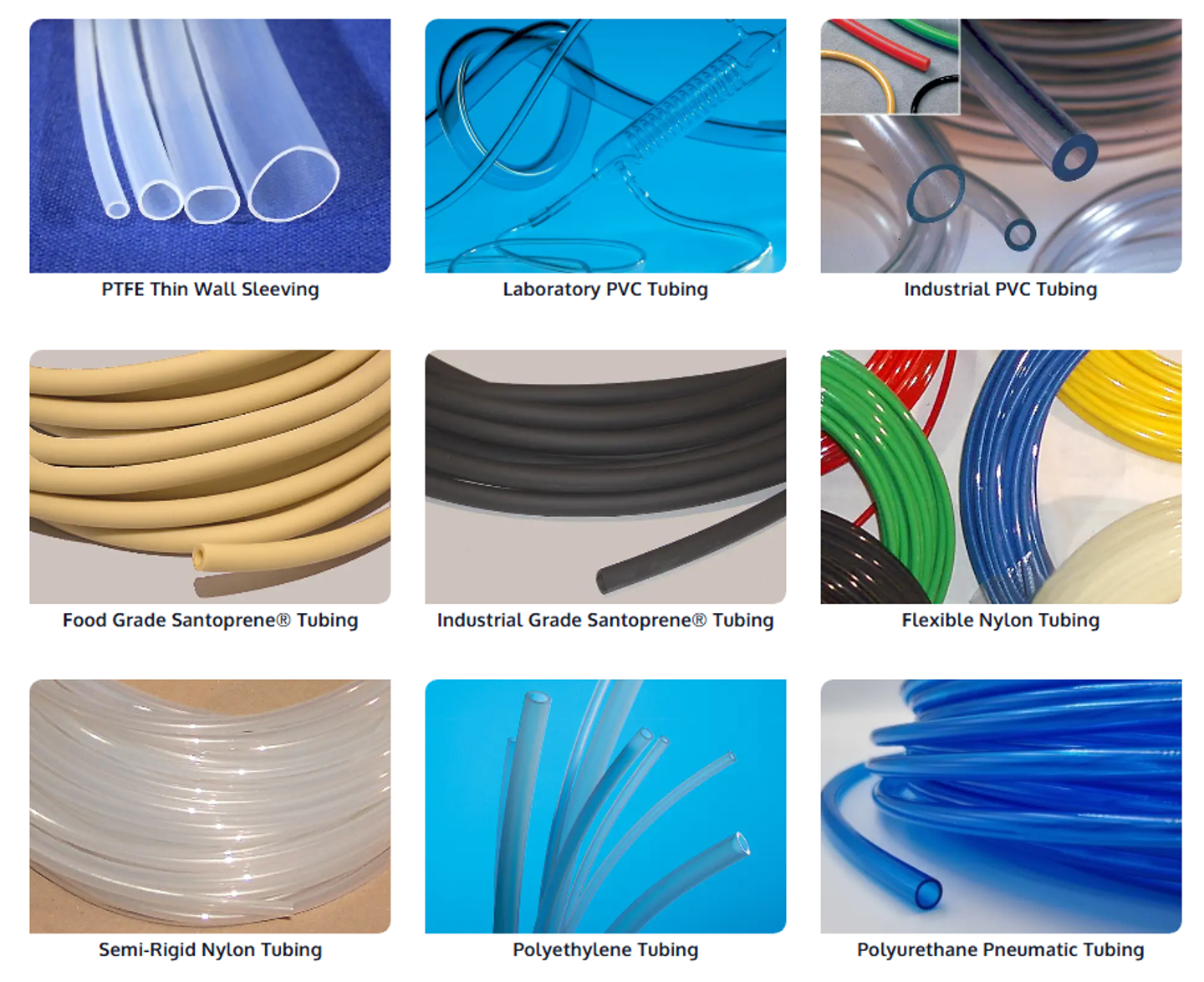
- PVC (vinyl): Economical, flexible, good for many fluids.
- Silicone: Food-grade, high-temperature, very flexible.
- Polyurethane: Abrasion resistant, flexible, kink-resistant.
- Teflon (PTFE/FEP): Chemically resistant, high-temp, less flexible.
- Rubber (EPDM, nitrile, neoprene): For high durability, pressure, or chemical resistance.
Nylon / Polyethylene: Lightweight, chemical-resistant, semi-rigid.
🧯 7. Are there regulatory or safety requirements?
- Does it need to meet FDA, NSF, USP Class VI, RoHS, or UL standards?
- Will it be used in food, medical, or pharmaceutical applications?
Is flame resistance or anti-static performance required?
💰 8. What are the logistical and cost considerations?
- Expected lifetime or replacement frequency.
- Budget constraints.
Availability and lead time.
Contact us today or shop now.